
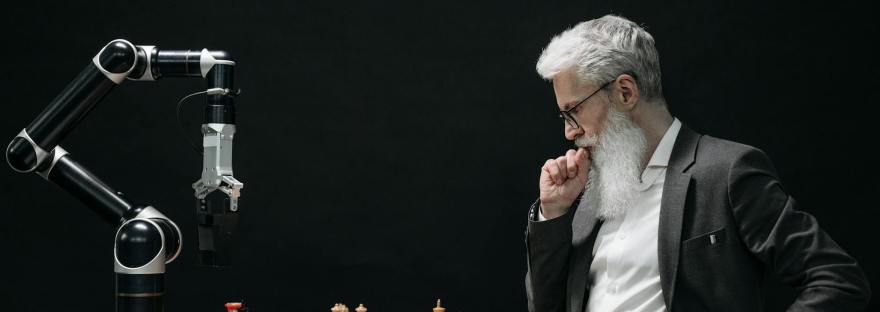
Artificial Intelligence (AI) is no longer a futuristic concept. It’s here, it’s powerful, and it’s rapidly changing the way we live and interact with the world. For Christians, this brings both opportunities and serious concerns. My goal here is not to stir up fear, nor to encourage blind acceptance, but to call believers to thoughtful, biblically grounded engagement with this technology. Let’s look at a few guiding principles.
Evil Is Not a Substance, and AI Is Not a Sinner
Evil isn’t a dark goo lurking in machines or spaces. Evil is wrongdoing, which is sin. And sin, by definition, is disobedience to God. Robots and AI cannot sin because they lack a soul, a conscience, and a will directed toward or away from God. Like guns, AI is a tool. Guns don’t kill people, people do. Similarly, AI can be used for great harm or great good. The moral responsibility lies with those who create and use it.
Romans 14:23 reminds us that “whatever does not proceed from faith is sin.” James 4:17 adds, “So whoever knows the right thing to do and fails to do it, for him it is sin.” It’s our use or misuse of AI that matters before God.
Caution Is Wise, and Scripture Should Shape Our View
As with all technology, AI must be evaluated critically through the lens of Scripture. We are not called to naïve optimism, or cynicism, but to wisdom.
Daniel 7 may offer a prophetic image of modern technological power. The passage describes a “little horn” with eyes “like” the eyes of a man that speaks blasphemies. Horns in biblical apocalyptic literature often symbolize leaders or rulers, and eyes may represent intelligence or insight. The picture here might resemble what we are seeing unfold: an intelligence that appears human but is not human, and is speaking.
Genesis 11:6, describing the Tower of Babel, sounds eerily relevant: “And the Lord said, ‘Behold, they are one people, and they have all one language, and this is only the beginning of what they will do. And nothing that they propose to do will now be impossible for them.’” Then, as now, humanity gathered in its cities with its towers, unified in language and ambition, ignoring God’s call to fill the earth and steward it in His name.
Today, we face a Babel-like moment again, striving to become gods through our own ingenuity, and making our own name great.
Romans 14 and the Ethics of Conscience
AI is not mentioned in Scripture, so it falls into the category of ethical “gray areas” or matters of conscience. Paul’s entire discussion in Romans 14 teaches us how to navigate these issues. Whether it’s food, drink, holy days, or technology, the principle is the same: we don’t pass judgment on fellow believers whose conscience differs from ours.
Some Christians will feel comfortable using AI. Others will not. We must not shame each other. Instead, we seek to honor God in our decisions and allow room for differing convictions.
Not Everything Permissible Is Profitable
Just because we can do something doesn’t mean we should. This applies directly to AI. While learning about it is not wrong, we must ask, what is its ethical use?
We don’t need to make AI commit immoral acts just to demonstrate how dangerous it is. Paul cautions against this mindset in Ephesians 5:12: “For it is shameful even to speak of the things that they do in secret.” In other words, exposing evil doesn’t require us to replicate it.
If we truly are “lights in the world” (Philippians 2:15), then we should model a different way forward. Some argue, “If we don’t develop AI in this or that way, others will.” But that’s the same logic a thief uses when stealing from an unlocked car: “If I don’t do it, someone else will.”
Romans 8:7 says that the mind set on the flesh “does not submit to God’s law; indeed, it cannot.” But we are not of the flesh. If anyone can question the ethics of unchecked technological development, it should be us.
At the same time, let’s have more faith in God’s sovereignty than in the inevitability of evil. The world is, after, not as evil as it could be, by God’s own restraint.
Is History Shaped Like a Chiasm?
Here’s something fascinating. Many sections of Scripture are written as chiasms: a structured like a mirror image, pointing to a central theme.
The center of Lamentations highlights God’s faithfulness (the inspiration for Great Is Thy Faithfulness).
Leviticus places the Day of Atonement at its heart.
In Genesis 8:1, the flood narrative turns on a hinge in the middle: “God remembered Noah.”
The entire book of Esther is structured as a chiasm, pointing to God’s hidden but sovereign hand.
These structures don’t just aid memorization, they show us what matters most.
Now consider history itself. The Bible begins in a garden and ends in a garden-city. At the center is Christ—His birth, death, and resurrection. Near the beginning was the Tower of Babel. And perhaps, near the end, we are witnessing a similar defiance and ambition.
If the biblical story is chiastic, then the Babel of Genesis 11 may mirror our modern technological moment. This doesn’t mean we should predict exact timelines, but it should remind us that Christ is coming soon, and history is not spiraling out of control, it’s unfolding according to God’s design.
In Summary
AI is a tool. Like a gun, it can be used for protection, provision, or destruction. Evil doesn’t live in tools. It lives in human hearts.
We should approach AI cautiously but without fear. God is not wringing His hands in heaven. He holds AI under His pinky.
Some Christians will use AI. Others won’t. Let’s not judge each other. But let’s all be discerning. Let’s not trust what AI says without scrutiny. Let’s not assume what we see is real (which is tempting especially when we want to believe it is)! Let’s not be ignorant of its power to deceive.
I’ve created realistic videos using AI that convinced people they were watching real interviews. If I can do this in seconds with no budget, what can governments or bad actors do? AI can mimic reality.
But we have something more powerful than artificial intelligence: we have the truth of God’s worth by His grace through faith in Christ. And we are called to walk in that truth with both humility and courage.
 Adorn the Gospel